
Building the NSW North Coast Line in Open Rails
Some projects begin with careful planning.
This one began with curiosity.
For years I’d been fascinated by the railways around Grafton. Growing up in Northern New South Wales, the North Coast Line was simply part of life. Trains crossing the Clarence River bridge, locomotives working South Grafton yard and stories from people who remembered when steam still ruled the rails.
One of those people was my father.
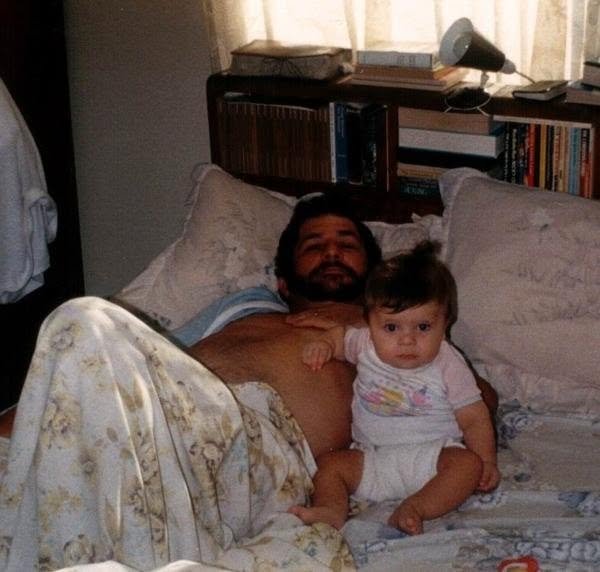
Although I lost him when I was only eighteen months old, somehow the fascination with railways found its way to me. Whether it came through family stories, old photographs or simply growing up surrounded by railway history, I’ve always found myself returning to it.
Like many hobbies…
It started small.
I simply wanted to drive some NSW locomotives again.
Rediscovering Open Rails
Initially my goal wasn’t to build anything.
I wanted to relive the experience of driving the locomotives I’d admired growing up.
That journey led me to Open Rails.
From there came locomotives.
Rolling stock.
Routes.
Then sound modifications.
Before long I was editing ENG files, rebuilding sound systems, fixing locomotives that hadn’t worked correctly for years and assembling what quickly became one of the largest collections of NSWGR content I’d ever owned.
But while driving existing routes was enjoyable…
Something always felt missing.
The places I knew weren’t there.
South Grafton.
North Grafton.
Glenreagh.
The Dorrigo Branch.
The Clarence River bridge.
The Peter’s Ice Cream factory.
These weren’t simply locations on a railway.
They were places connected to memories.
Standing on the Shoulders of Giants
One thing became obvious almost immediately.
I wasn’t starting from nothing.
For more than two decades an incredibly passionate Australian train simulation community has quietly preserved our railway history through Microsoft Train Simulator and, more recently, Open Rails.
Without their work, this project probably wouldn’t exist.
One of the first routes that genuinely inspired me was Coals to Newcastle.
It wasn’t simply enjoyable to drive. It demonstrated just how much could still be achieved using technology that many people considered long obsolete.
More importantly, it became an invaluable learning resource.
By exploring how that route had been constructed, I slowly began understanding how track databases, scenery, signalling, terrain, activities and route structure all worked together behind the scenes.
That naturally led me to another legendary Australian resource.
Although the original website has long since disappeared, thanks to the Internet Archive’s Wayback Machine and the dedication of countless community members, much of its content still survives.
That archive became an incredible source of Australian locomotives, rolling stock, routes, utilities, tutorials and reference material.
It also introduced me to routes I had never previously experienced, including sections of the NSW network that helped me better understand how Australian MSTS route builders approached scenery, terrain and signalling.
Many of the assets, utilities and techniques used throughout this project can trace their origins back to those preserved archives.
This project isn’t simply built on my own work.
It’s built upon twenty years of knowledge generously shared by countless Australian route builders before me.
One Diagram Changed Everything
Around this time I was fortunate enough to inherit something incredibly special.
An original NSWGR track diagram of South Grafton yard that had belonged to my father.
The paper had yellowed with age.
Fold marks covered the page.
It had clearly lived a long working life.
I photographed it section by section before digitally stitching the entire diagram back together into a high-resolution copy.
For the first time I wasn’t relying on memory.
I had the railway exactly as NSWGR engineers had drawn it.
That single document transformed the project from wishful thinking into something genuinely achievable.
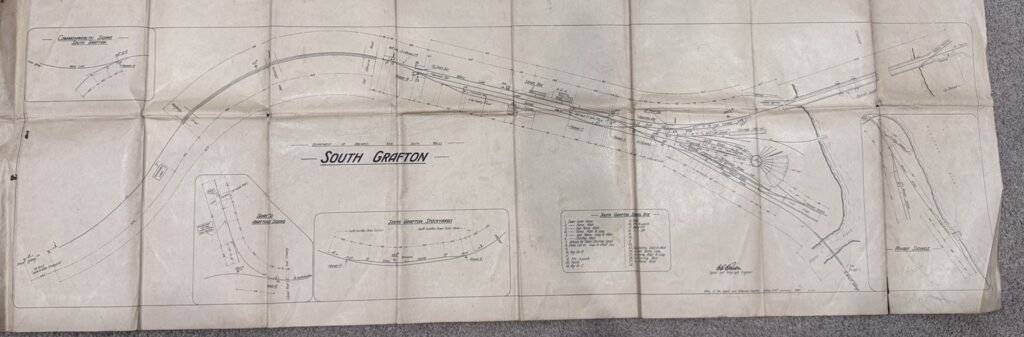
Original South Grafton yard diagram.
Then the Rabbit Hole Opened
Once I started looking…
I couldn’t stop.
Historical aerial photography.
Light Railways magazines.
Archive websites.
Forgotten downloads.
Facebook groups.
Google Earth.
Every answer seemed to create three new questions.
One evening I sat down intending to lay a kilometre of track.
Three hours later I had done nothing except research timber bridge construction and compare aerial photographs from different decades.
That has happened more than once.
Learning Before Building
Before a single kilometre of railway could be built…
There was another skill to learn.
TSRE5.
Like many enthusiasts, I’d heard about it for years.
Actually building a route with it, however, proved to be an entirely different experience.
The first week consisted almost entirely of learning how the editor thought.
Finding missing assets.
Understanding REF files.
Importing scenery libraries.
Tracking down missing textures.
Discovering keyboard shortcuts that weren’t obvious.
Working out why bridges appeared fluorescent pink.
Recovering from editor crashes.
Learning how the Track Database behaved.
Every mistake taught another lesson.
Some of those discoveries have already become indispensable:
- X flips curved track placement direction.
- R together with the numeric keypad adjusts track orientation and elevation while laying track.
- Z temporarily removes selected track from the Track Database, allowing adjustments before reconnecting it.
- F applies the TSRE’s embankment tool setting for shaping terrain around selected track.
- REF file formatting is surprisingly sensitive and can determine whether scenery appears at all.
- Missing ACE textures usually mean the model exists, but one texture file doesn’t.
- A single hidden piece of rogue track can stop Open Rails from spawning a train.
- A tiny file called
cerecent.txtcan prevent TSRE from opening an otherwise healthy route.
Most of these lessons weren’t found in documentation.
They were discovered one problem at a time.
This Isn’t Just About Building a Route
The more time I spend on this project, the more I realise it isn’t simply about creating another Open Rails route.
It’s about preserving a small piece of railway history.
Many of the locations I’m recreating have already disappeared.
Station buildings have burned down.
Yards have been simplified.
Sidings have been removed.
Industries have closed.
Yet through old photographs, original diagrams and the incredible work of the Australian train simulation community, those places can still be recreated.
If this project succeeds, perhaps someone else will one day drive across the Clarence River bridge, stop at South Grafton, work North Grafton yard and continue towards Casino exactly as trains once did.
That thought alone makes every hour worthwhile.
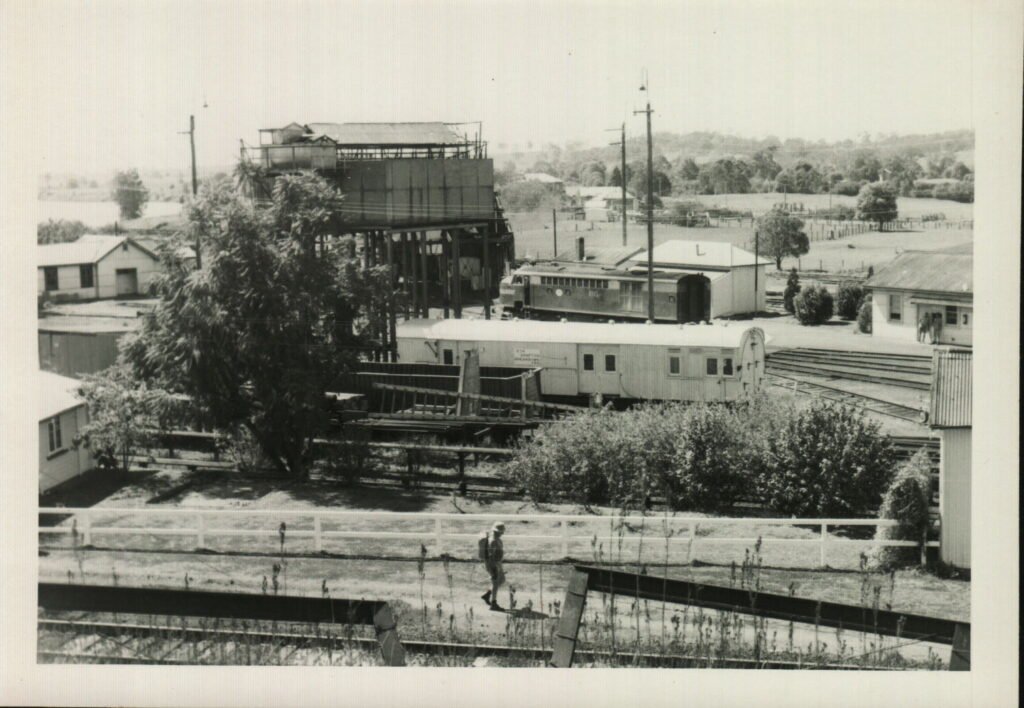
PVC Grafton Loco Sept 1976
So Here We Go…
The software is installed.
The locomotives are ready.
The research has begun.
There is only one thing left to do.
Lay the first piece of track.
Next Entry
Developer Journal #1
“It Started With One Piece of Track…”